
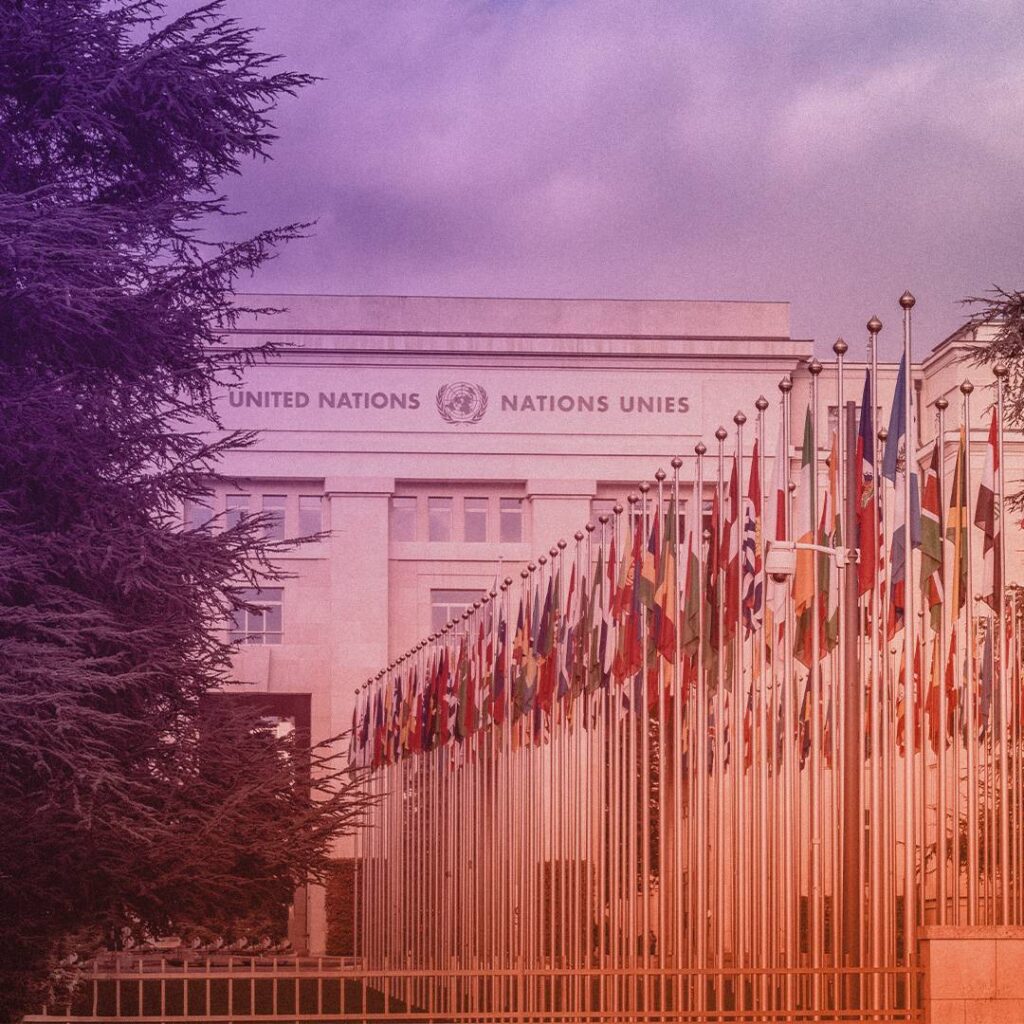
A goal from day one. When we founded Guardians of Equality Movement (GEM) in 2021, we set out to document the experiences of LGBTQIA+ Syrians in a dedicated report and put concrete recommendations before the UN. We made that commitment public in our early advocacy. This was a long-term strategy: from the outset, we set rigorous standards for our reporting and analysis so that the evidence we gathered could support a dedicated UPR submission and sustained advocacy with governments. In June 2026, we turned that vision into action by submitting the first standalone civil society report devoted to LGBTQIA+ rights in Syria for the United Nations’ Universal Periodic Review (UPR). Read GEM’s early UPR commitment.
What the UPR is and why it matters
The Universal Periodic Review (UPR) is a UN Human Rights Council process that examines the human rights record of each of the 193 UN Member States roughly every four and a half years. Before the review, civil society organisations and other stakeholders can submit evidence and brief diplomats. During the review, other UN Member States can draw on those submissions, alongside information from the UN and the country under review, to recommend concrete steps to improve human rights. The recommendations and the country’s responses are made public, so communities can track what their government commits to and whether it follows through. Read the UN guide to the UPR.
As Syria’s transitional authorities seek international support and recognition, governments have an opportunity to press for specific reforms. Through the UPR, they can put recommendations on the record and ask Syria to report on the steps it takes to carry them out.
The gap we set out to close
Before 2022, Syria had never received a UPR recommendation specifically addressing LGBTQIA+ rights. Its third review marked a change: five governments made recommendations explicitly addressing LGBTQIA+ rights. Read about the earlier UPR cycles.
| Country | UPR number | Focus |
|---|---|---|
| Albania | 133.83 | Prevent sexual and gender-based violence, including against LGBTI people, and hold perpetrators accountable. |
| Uruguay | 133.86 | Decriminalise consensual same-sex relations and protect people from sexual violence and other serious abuses. |
| Italy | 133.91 | Decriminalise consensual same-sex relations between adults. |
| Iceland | 133.92 | Decriminalise consensual same-sex relations between adults. |
| Fiji | 133.207 | Prevent violence based on sexual orientation or gender identity, support survivors and remove barriers to justice. |
Although LGBTQIA+ concerns had appeared in broader human rights reporting, a standalone submission dedicated to these communities was still missing. The 2022 recommendations gave us a starting point. GEM set out to bring together the experiences of LGBTQIA+ Syrians, the laws and practices affecting them, and concrete changes governments could ask Syria to make. Read the 2022 UPR recommendations.
GEM built the report on years of research, case documentation and protection work with Syrian LGBTQIA+ communities. We led the submission in partnership with The Advocates for Human Rights.
What the report documents
Despite the political transition, Syria still criminalises consensual same-sex relations. The February 2026 general amnesty excludes Article 520 offences. Read the February 2026 amnesty decree.
The report examines how criminalisation affects everyday decisions, including whether someone who has been threatened or assaulted can safely go to the police. GEM’s legal research documents how people who seek protection can risk harassment or arrest themselves. That fear makes it harder for survivors to report abuse and seek justice. Read GEM’s research on the legal position of LGBTQIA+ people in Syria.
The submission also draws on abuses documented since December 2024, including entrapment through dating apps, arbitrary detention, torture and forced filming. GEM’s April 2025 research recorded a 70% increase in requests for support and assistance from LGBTQIA+ people inside Syria after the fall of the Assad regime. Read GEM’s research on the situation after December 2024.
What we’re asking governments to recommend
- Repeal Article 520 and immediately suspend arrests and prosecutions for consensual same-sex relations while repeal is pending.
- Release those arbitrarily detained. Immediately release everyone detained solely because of their actual or perceived sexual orientation, gender identity or expression, or consensual same-sex relations, and end all prosecutions on those grounds.
- End discriminatory policing, including arbitrary arrests and dating-app entrapment targeting people because of their actual or perceived sexual orientation or gender identity.
- Prevent torture and ensure accountability. Effectively implement Law 16/2022. Independently investigate torture, ill-treatment and sexual violence by State and non-state actors, including in detention, and prosecute those responsible where warranted. Ensure confidential complaints, access to legal counsel and medical care, independent detention monitoring, a ban on forced anal examinations and protection from reprisals.
- Ensure safe services and survivor protection. Within 12 months, establish confidential reporting and referral pathways and guarantee non-discriminatory legal aid, healthcare, psychosocial support, emergency shelter and reparations. This includes implementing Croatia’s supported recommendation 133.205 on medical treatment and psychosocial support for survivors of sexual and gender-based violence.
- Ensure inclusive transitional justice. Ensure safe, voluntary and confidential participation of LGBTQIA+ survivors in transitional justice and missing-persons processes. Review the transitional justice authority’s mandate so that accountability and remedies address violations by all parties, including abuses since December 2024.
- Guarantee equality and protection. Adopt and enforce comprehensive anti-discrimination protections covering actual or perceived sexual orientation, gender identity and expression, and sex characteristics. Protect LGBTQIA+ human rights defenders and ensure non-discriminatory access to public services.
- Establish independent oversight and follow-up. Within 18 months, establish an independent national human rights institution consistent with the Paris Principles, building on Bangladesh’s 2022 recommendation 133.79. Enable secure civil society engagement and publish annual UPR implementation updates without exposing survivors.
Taking the recommendations to Geneva
On Tuesday, 17 November 2026, GEM’s Founder and Executive Director, Francois Zankih, will present these priorities at Syria’s UPR pre-session at the Palais des Nations. Throughout the week, GEM is also briefing diplomatic missions and asking governments to renew earlier recommendations and make them more specific about the steps Syria should take. View the pre-session programme.
Submitting the report fulfilled a commitment GEM made at its founding. Our work now is to get these recommendations raised during Syria’s 2027 UPR and to follow up on what Syria agrees to do. For the communities whose experiences shaped this report, progress means being able to seek protection, report abuse and access justice without fear of arrest.