
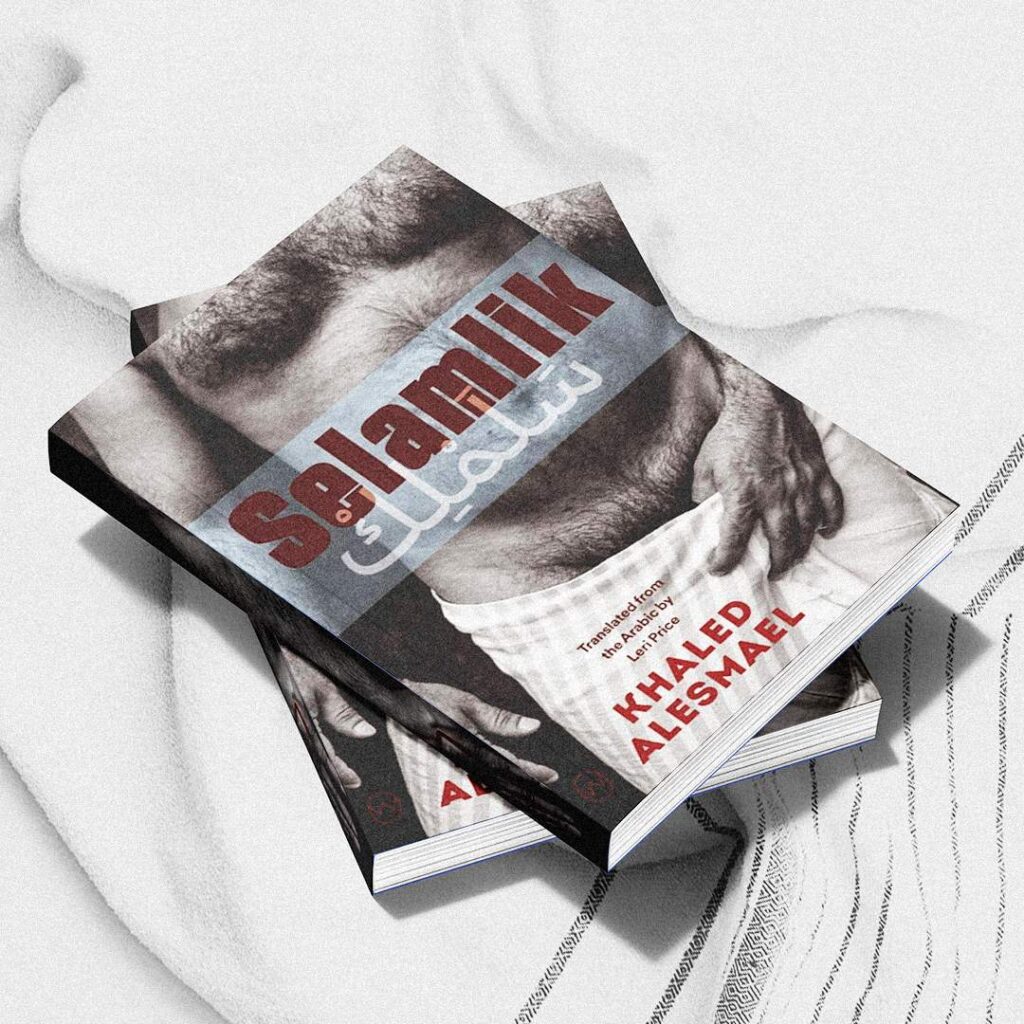
In the vast Syrian library, brimming with narratives of war, displacement, and authoritarianism, one rarely encounters a literary work that acts as a mirror—one that transports us through time and space from a different vantage point. But what if that mirror were queer? In that case, there are perhaps only a handful of such works.
The novel Salamlik transcends traditional literary classifications. A reader might place it within “exile literature” or “erotica,” yet it has asserted itself as a socio-political and queer documentary map. Across ten chapters, the book navigates geography and history, oscillating between the dualities and transformations of the body and emotion. The journey begins with the “announcement of the Dictator’s death” and concludes in the frost of Scandinavian cities, passing through the brutality of war, displacement, and the intricacies of the gay experience.
Note: The term “eroticism” is used here to describe an artistic, literary, or visual depiction of sexual desire and physical love within a symbolic, aesthetic, and creative framework, focusing on emotion and sensory states from a purely artistic lens.
Why Read Salamlik
Because it is not merely a personal narrative; it is a fresh literary re-reading of modern Syrian history from the shadows. Here, politics and gender identity intersect with spatial memory. The story is penned by Khaled Al-Ismael, a Syrian writer and journalist who has received several honors and nominations for his journalistic and literary works. The book’s title, Salamlik, refers to the traditional “men’s quarters” in Ottoman architecture.
In the Gray Zone: Between Two Eras
In its chapters, the author depicts the internal confusion of the protagonist—a university student navigating various emotional relationships—against the backdrop of a pivotal event that defined a new era for Syrians: the death of Hafez al-Assad.
“This was supposed to be a happy occasion… thirty years of dictatorship…”
Through the eyes of the protagonist, the book captures those moments with a unique description of the collective psyche in what could be called a “gray zone” between two reigns: the dead silence on the bus, the anchor on Syrian State TV, the Parliament, the security apparatus… alongside numerous situations spanning two decades.
A Temporal Queer Map
The value of this book—which touches on the pre- and post-dictator eras, the revolution, the siege, detention, and exile—lies in its role as a queer archive. It does not only testify to the relative “openness” of Damascus and the secret gathering spots of its queer community before and after 2011; it does so using a high literary style and sophisticated, fluid imagery.
The narrative flows with a sensory, erotic rhythm that simultaneously probes the depths of the characters’ motivations without neglecting their human dimension or their entanglement with a war fraught with sectarian and religious sensitivities. It reveals the profound depth of same-sex relationships among Syrians.
For the author, tracing the scars of war is not limited to depicting its general brutality. Instead, he invites us to pause at the fragility of the body in the face of the machinery of oppression: “This faggot must be killed.” Yet, with seamless grace, the bitterness of death and destruction is tempered by soaring into—and lingering within—warm memories.
Ultimately, Salamlik is more than just a series of homoerotic events set against the backdrop of war. It is the story of an entire generation caught between extremes. It is a tale of love in the age of fear, and a journey through Syrian memory spanning decades from a perspective rarely seen.